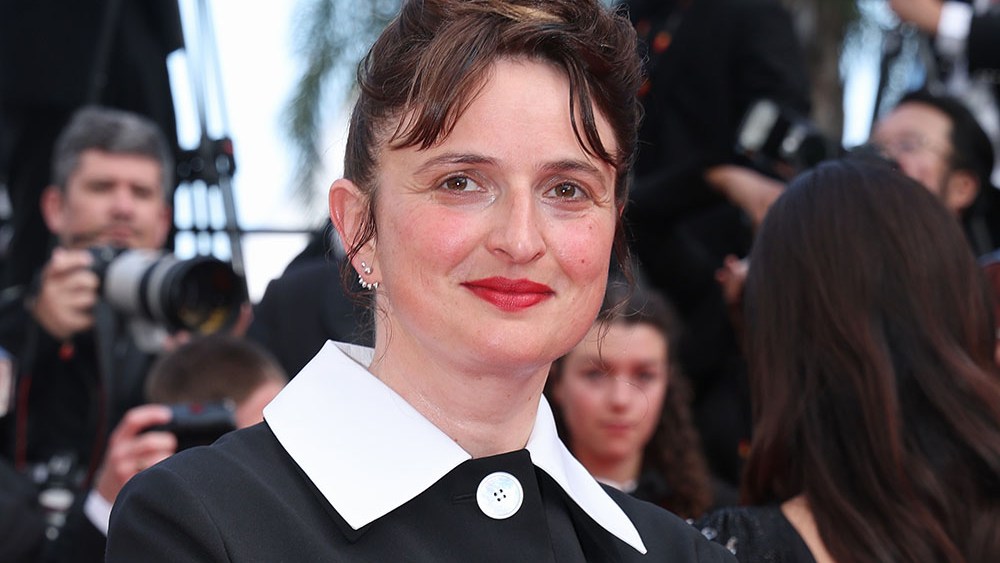

Italian director Alice Rohrwacher, known for highly original works “The Wonders,” “Happy as Lazzaro” and “La Chimera” — all of which competed at Cannes Film Festival — is taking her exploration of cinematic language to a bold new level by shooting a silent movie.
Rohrwacher, 44, who will be honored on Saturday in Berlin at the European Film Awards with the European Achievement in World Cinema prize, revealed this distinctive aspect of her next project to Variety during a wide-ranging interview. Reflecting on her illustrious career thus far, Rohrwacher says she has been “trying to understand why, in this world that is so battered with images, it’s still so necessary to rely on an image in order to deconstruct the images that surround us.”
Rohrwacher’s silent movie, which she is currently prepping — but is staying mum about in terms of details — will be “a great opportunity to really delve deeply into images” and “to find their power through subtraction,” she says. Below, Rohrwacher speaks more about receiving an EFA honor, the importance of her collaborators and what’s next.
How does it feel to get such an important honor after making just four features?
Well, even though there are only four feature films, it’s been a long journey of discovery. Partly because between one film and the next, there have been shorts and various types of documentaries. But also because our approach is so curated, I’d say so deep, that it actually feels like I haven’t stopped for a moment. When they called and told me they were awarding me this prize, at first I thought there was a mistake. In the sense that, yes, it’s been a long journey. But that there’s still a very, very long journey to come. And this journey really has to do with trying to understand why in this world that is so battered with images, it’s still so necessary to rely on an image in order to deconstruct the images that surround us. But I thought, I’m lucky that they are giving me this award now, because this way I can be free to make even crazier and more wrong-headed films. I’ve already received this important and prestigious award. So now, even more so, it seems to me like a call to dare even more, to search even further.
In its motivation for the prize the EFA writes, “With a careful eye for the realities of a teenager’s life and a big heart for the countryside, she creates a unique universe for each of her films.” Do these words reflect your vision?
It’s a beautiful and moving motivation. The gaze of those who look at us always reveal things to us that perhaps we can’t yet understand from within. I believe that for me the word “teenager” isn’t really about a specific age, meaning it’s not about adolescence per se, but about an inner adolescence. Because if I think about the protagonists of my films, they’re not just teenagers — except, perhaps, the first two. Maybe they are instead all teenagers in the sense that they potentially haven’t yet figured out where they belong. This state of adolescence of the soul seems important to me. Because if I think about the world, as it is defined today, I can’t see myself in it.
You’ve made all your features working with the great cinematographer Hélène Louvart. How is this collaboration an integral part of your work?
What unites us with Hélène is, first and foremost, a spirit of adventure and exploration that begins before the film begins. What unites are questions about what we’re doing and how to do it. I feel a great desire to work with her, precisely because we’ve now established such a strong relationship that’s also a relationship of great freedom to dare and try. And perhaps make mistakes, and then discover something else. So, beyond just working with one of the greatest cinematographers whom I believe exist on the planet, it’s about working with someone who has both the wisdom and the recklessness to find diversity each time she approaches a film as something new. And I like this, because both in the relationship with the crew and in the relationship with the film, there’s always a sense of novelty and exploration.
Tell me about working with Carlo Cresto-Dina and his Tempesta company, which has shepherded all your films to date.
[He] gave me the opportunity, and believed in what I could do before anyone else. He did this in a very instinctive way, without much basis to go on. Because when I made my first feature, I’d never made a short. I’d never worked with a crew. And so he was certainly very courageous, and that deserves recognition. I think this shows in the fact that this relationship has lasted so long, that somehow courage is something that unites us.
Can you tell me what your next project is?
I am working at more than one at the same time. My next project will be a silent movie, precisely in order to have this great opportunity to really delve deeply into images, to find their power through subtraction. Because of my great desire to use the image, the actor, and try to strip away everything that’s superfluous in the story and to see what we can still do [with that] today. I think that in any case silent cinema, and especially European silent cinema — the work of the great European masters — isn’t merely something that came before talking cinema. It’s a completely different medium of expression. And so I hope to be able to experiment with it.
This interview has been edited and condensed for clarity.
This Content is a Property of variety.com
For DMCA Complaints, Please Email at
dmca@enspirers.com